Sunday, March 25, 2018
A New Day A New Blog...
Well, to make a long story short, I gave up blogging with blogger and resorted to FaceBook posts on my last trip. Yes, I did do the whole Camino Frances again end to end and a helluva lot of sightseeing in Spain last year. Maybe when I get a quiet year I might have the time to write about it - at least the highlights. But that won't be soon if this year is anything to judge by.
I have another Camino planned and this time I am hoping to blog it all, in fact, I would like to take up my blogging habit again and make it a regular thing. We shall see. The first thing I have to do is get a better blogging tool than this Blogger site and software has turned out to be. So I am continuing my blogs on WordPress, you will find me here fumbling around for a bit as I figure out how it works. I have my fingers crossed that there will be a better access for composing offline and uploading pictures. Since Google purchased Blogger and Picasa they seem to be content to let them die a slow death, and that seems to not be the case with WordPress.
Hope you will wander over for a visit sometime... with encouragement I might be able to resurrect this blogging habit!
To Keep In Touch you just need to remember epeggyh... as in //https:epeggyh.wordpress.com.

Friday, May 19, 2017
Nájera - Day 13
Ok, so it is two steps forward and one step back... seems there is a spanner in the works keeping me from getting photos uploaded into the post, so I will write the blog and may need to post without pictures for the moment. *sigh* technology...
As you might have guessed from the title, I am in Nájera. Yesterday, as promised, was a cold and rainy day, at least it was full on rain until I finished up at Navarette about 1 p.m. My Altus raincoat is fabulous, it keeps me and my pack dry from the knees and elbows up despite several good long torrential downpours. I discovered the hard way that my boots are not very rainproof and in fact have a two inch tear on the uppers which lets the rain or puddle water free admission to the boot. It felt like I was walking in a mobile cold water foot bath. I arrived with prune feet and impossible to dry out boots. I also had to stop using my poles as the rain was running up my arms.
This morning I walked in my Keen hiking sandals and discovered that the money I'd spent on custom orthotics for my boots were well worth it. I can't use them in my sandals and after walking without them today I have the beginnings of a blister on my baby toe - same spot as last time. Tomorrow my boots will be dry and hopefully all will be well. On the plus side, I am sure I was more comfortable in my hiking sandals than wet boot.
I have found the most amazing little keyboard that weighs next to nothing and is tiny tiny. Sadly, when it comes to technology, nothing is perfect but it does solve some issues I have when using the viritual keyboard with the blogging software. I noticed that the keyboard was a Spanish one - that is with spanish letters and symbols, but discovered upon use that it is marked as a Spanish keyboard but the keys do not match the markings, and there is no evidence of Spanish letters e.g. the ñ and it isn't North American either so when I use it it is a bit of a hunt and peck exercise for special characters. It is really cute though and despite the downside, it is still better than the iPhone viritual keyboard which pops up on top of the text I am writing on my blogging software making it very difficult to see what I am doing. Did I mention that my preferred offline blogging software was abandoned by the developer when Google bought out and shelved the essential photo software (Picasa) which was used to house the blogs's photos? Google also bought out Blogger, my online blog software and while I can still use it it is now as buggy as hell. oh well.
My walk today was just 13 km long - I am settting a slow speed record. The weather was cool and partly sunny. Nice walking weather. There are a lot of people walking these days, and today we had an extra lot - some 20 or so students from the University of La Rioja, who were out for a 1 day jaunt. I chatted with a young man from Taiwan who explained that they were International Students from all over the world who were studying Spanish and Spanish culture at the University. They were skipping down the trail as only possible for someone out only for the day.
You may have noticed that I didnt blog yesterday as promised. Meeting a new cohort of Perigrinos takes time and lots of wine to both tell and be told the obligatory "bonding stories" (you will recall that my previous Pilgrim "family" as moved forward). Once you fall into the same pilgrim's company a number of times, you need to swap stories of origin, motivation and feet/leg/knee injuries. Having slowed my walk, I am now with the walking injured of my cohort and the regular walkers of the cohort which was once days behind me. I heard someone state today "I can't believe that I am 11 days in already". That is n-2 days from my start.
The other reason I didn't blog was that I spent an hour or so in joyous contemplation of my "transfer credit" report from York University. A brief explanation is in order for those of you who are not aware that I am in my 1st year of an undergraduate degree in English Literature and in the midst of a process to transfer to a different university that does not charge seniors tuition. I was amazed to discover that they granted me 45 transfer credits out of the 120 required for an honours degree. The rub is that I am not sure how many of these credits apply to the English courses in my program. The admissions office granted me 1 3 credit course with a promise that the English department may decide to give me more. We shall see. The did say that they waived all the general education courses so it seems that I will just need to take the English courses. I am very happy with this news.
I am staying tonight at the Puerta de Nájera albergue. I chose that one over the 90 beds in 1 room municipal abergue I stayed in last time. It is a vast improvement. Once I can add some pictures you will see why. Last night I stayed in El Cántaro. Not recommended. While the room was fine - 5 beds (no bunks) in a room but it was in a 2nd floor unit of an apartment building with the living room covered to a bedroom. For 10 EU I expected better - at least a common room. Today's was 10 EU as well, but it is far nicer.
Tomorrow I will walk only about 16 km to Circeña. It is a little bit of a climb and about 6km short of the next large city - Santo Domingo. More about that in my next blog.
If you haven't read my blog from my last walk of this section (or want to see some pictures from the wonderful La Rioja wine area, go hereL:
As you might have guessed from the title, I am in Nájera. Yesterday, as promised, was a cold and rainy day, at least it was full on rain until I finished up at Navarette about 1 p.m. My Altus raincoat is fabulous, it keeps me and my pack dry from the knees and elbows up despite several good long torrential downpours. I discovered the hard way that my boots are not very rainproof and in fact have a two inch tear on the uppers which lets the rain or puddle water free admission to the boot. It felt like I was walking in a mobile cold water foot bath. I arrived with prune feet and impossible to dry out boots. I also had to stop using my poles as the rain was running up my arms.
This morning I walked in my Keen hiking sandals and discovered that the money I'd spent on custom orthotics for my boots were well worth it. I can't use them in my sandals and after walking without them today I have the beginnings of a blister on my baby toe - same spot as last time. Tomorrow my boots will be dry and hopefully all will be well. On the plus side, I am sure I was more comfortable in my hiking sandals than wet boot.
I have found the most amazing little keyboard that weighs next to nothing and is tiny tiny. Sadly, when it comes to technology, nothing is perfect but it does solve some issues I have when using the viritual keyboard with the blogging software. I noticed that the keyboard was a Spanish one - that is with spanish letters and symbols, but discovered upon use that it is marked as a Spanish keyboard but the keys do not match the markings, and there is no evidence of Spanish letters e.g. the ñ and it isn't North American either so when I use it it is a bit of a hunt and peck exercise for special characters. It is really cute though and despite the downside, it is still better than the iPhone viritual keyboard which pops up on top of the text I am writing on my blogging software making it very difficult to see what I am doing. Did I mention that my preferred offline blogging software was abandoned by the developer when Google bought out and shelved the essential photo software (Picasa) which was used to house the blogs's photos? Google also bought out Blogger, my online blog software and while I can still use it it is now as buggy as hell. oh well.
My walk today was just 13 km long - I am settting a slow speed record. The weather was cool and partly sunny. Nice walking weather. There are a lot of people walking these days, and today we had an extra lot - some 20 or so students from the University of La Rioja, who were out for a 1 day jaunt. I chatted with a young man from Taiwan who explained that they were International Students from all over the world who were studying Spanish and Spanish culture at the University. They were skipping down the trail as only possible for someone out only for the day.
You may have noticed that I didnt blog yesterday as promised. Meeting a new cohort of Perigrinos takes time and lots of wine to both tell and be told the obligatory "bonding stories" (you will recall that my previous Pilgrim "family" as moved forward). Once you fall into the same pilgrim's company a number of times, you need to swap stories of origin, motivation and feet/leg/knee injuries. Having slowed my walk, I am now with the walking injured of my cohort and the regular walkers of the cohort which was once days behind me. I heard someone state today "I can't believe that I am 11 days in already". That is n-2 days from my start.
The other reason I didn't blog was that I spent an hour or so in joyous contemplation of my "transfer credit" report from York University. A brief explanation is in order for those of you who are not aware that I am in my 1st year of an undergraduate degree in English Literature and in the midst of a process to transfer to a different university that does not charge seniors tuition. I was amazed to discover that they granted me 45 transfer credits out of the 120 required for an honours degree. The rub is that I am not sure how many of these credits apply to the English courses in my program. The admissions office granted me 1 3 credit course with a promise that the English department may decide to give me more. We shall see. The did say that they waived all the general education courses so it seems that I will just need to take the English courses. I am very happy with this news.
I am staying tonight at the Puerta de Nájera albergue. I chose that one over the 90 beds in 1 room municipal abergue I stayed in last time. It is a vast improvement. Once I can add some pictures you will see why. Last night I stayed in El Cántaro. Not recommended. While the room was fine - 5 beds (no bunks) in a room but it was in a 2nd floor unit of an apartment building with the living room covered to a bedroom. For 10 EU I expected better - at least a common room. Today's was 10 EU as well, but it is far nicer.
Tomorrow I will walk only about 16 km to Circeña. It is a little bit of a climb and about 6km short of the next large city - Santo Domingo. More about that in my next blog.
If you haven't read my blog from my last walk of this section (or want to see some pictures from the wonderful La Rioja wine area, go hereL:
http://peggysbucketlistadventures.blogspot.com.es/2015/05/najera-to-granon-may-17.html
Buenas Noches mes Amigos!
Wednesday, May 17, 2017
Logroño - Day 10

I arrived in Logroño yesterday. This is the view that greets you as you enter the city. Not too shabby. Logroño is located on the Ebro river and is the capital of the autonomous community of La Rioja (as in the well known wine region). Population 151,000.

I am staying at the Entresueño Albergue, right on the main drag, on Portales. It is a wide boulevard filled with sidewalk cafes and shops in the centre of all the action. Just perfect. I am sitting at a cafe with a glass of local wine while I write this. I took today as a "rest day", meaning staying in place, walking the city rather than to a new location. I spent most of today trying to sort out my blogging software and after mucho hours I seem to be in business. Well, as best as I am going to be anyway. I could bore you with a long description of the challenges in getting this together, but I can feel your eyes gloated over at the thought. I have to catch up with the blogs, but I will start with today and try to both keep up with future days and slowly catch up with those I have missed.

This is the crowd I have been loosely travelling with. We all met in St. Jean Pied de Port and for the most part have pretty much kept together (minus 2 losses due to injury) for the last 10 days but yesterday the group seemed to come undone when time pressures and other priorities resulted in a divergent path for many of us. I am in no rush as I have plenty of time to mosey down the camino trail, but others are on tighter schedules. So it seems I am falling behind. The good news is that I may have more time to blog. That said, my blogging software is not working well and taking me a long time since it is screwing up regularly. Hopefully I can get things sorted out.


We got to see some performance art in the main plaza yesterday. Apparently this is what happens when you have too much "informatíca". Looked like a disaster practice for the Red Cross in the war of the boat anchor PCs. LOL
I am heading to Navarette tomorrow - about 12 km - and according to the weather forecast I will be walking during a full day of rain. Good thing I brought my Altus raincoat, which covers my pack and keeps me dry above the knees. Perhaps tomorrow's picture will be me impersonating a drowned rat.
Well it seems that the rain is almost upon us so I will need to abandon my courtyard and seek cover. Will post this and try and sort out some more software wrinkles before posting again. Buenas Tardes.
One thing you may wish to check out is my last blog when I walked the Camino in 2015. I have been dying to catch the town's I missed last time (hence Logroño), last ime I walked from Viana to Navarette from Estelle. This time I will walk tfromn Logrono to Logroño. Anyway, if you want more Camino blog of a similar time of year in a place about 10 km east, go here>
Saturday, May 6, 2017
A New Camino Begins

Unfortunately, the google software blogging software is not available offline, so I may not be able to post as often. We shall see.
Friday, November 27, 2015
The last week at San Miguel
It has been a busy week, and I scarce have time to write this blog before I head out on today's trip to Comonfort, a small town to the south-east of here to shop. So I will be brief with my text and promise more commentary and some SMA observations on my blogs yet to come.
 "
"Tuesday, we bussed out to the "Tuesday Market", on the edge of town. The local buses are cheap and frequent here on the main routes - only 5 pesos a ride. First we visited the real mall - an outdoor mall with an almost tastefully subdued MacDonalds (no Golden Arches) - the only fast food joint I have seen since coming.

The Tuesday market is a big flea market style market which is set up for a day in San Miguel and moves to another community for the next day. It is huge and it is hard to believe that they put everything out for the day and then pack it up and haul the stuff elsewhere, only to do the same again tomorrow. There were all manner of stuff and at reasonable prices.


On the way back to the centre of the city we wandered into the gardens at the Hotel Misión, which hosts the local Rotario Service Club. They are having a pancake breakfast on Saturday.


As we walked back to town, we wound our way down the big hill upon which half the town is perched. There were stairs down and some very nice condos with spectacular views.

On Wednesday, we went to a friend's home for a pot luck lunch and a few games of Rummikub. I had never played it before but it was easily learned and lots of fun. Organized games are big in SMA - some clubs meet in the various bars and cafes and others meet in homes. There is also a Pickleball League here which plays every weekday morning. Rummikub was a little like rummoli and a little like dominos - matching tiles on the table to get rid off the tiles in your hand.

That night we went to Los Milagros for their 2 for 1 happy hour for the senior set. For only 60 pesos (less than $5.00!) and we got dinner as well! They served a complementary plate of enchiladas as part of their 2 for 1 offer. There were about 20 of us sat around a long row of joined up tables, enjoying the live music. This is a must go stop for a lot of the local gringos each week.

Thursday was American Thanksgiving and Marc and Sue's friend Ellen was kind enough to extend an offer for me to attend. We all brought a dish or two and so there was enough food for an army!

Down the street from my Casa is a garage which uses the street as its repair bays. Quite frequently, when I am walking by, they are preparing and painting cars right on the street.

I am heading into my last days here, so not sure if I will get to write another blog before I am on my way home. Tomorrow we are taking a bus into the larger city of Guanajuato to spend the day site seeing. Sunday there is a gallery opening followed by a Grey Cup party. Monday morning I am being whisked to the Queretaro airport for my flight home.
I plan to write a blog to reflect on my time here and compare it to my previous "wandering pilgrim" holiday, walking across Spain. Stay tuned next week for that.
Buenos noches mi amigos!
 Posted with Blogsy
Monday, November 23, 2015
Going out to the Campo to Zandunga
Yesterday, we went with a friend of Marc and Sue's to an afternoon meal/musical event at a venue out in the campo - the country - to an event known as Zandunga, which is held every Sunday afternoon. For 400 pesos we got an all you can eat Mexican buffet and a small sample marguarita and a few hours of music in a beautiful country setting. It was the first time I had been out of the city since arriving at SMA and it was wonderful to get out and see some wide open spaces, fields mostly, with a gentle foothills mountain backdrop.


 |
| A relaxing afternoon! |
 |
| Waiting in line for food |
There were samples of local olives and olive oil to scoop up while in line.

We were served 2 quesadillas of choice (I had the pollo de chipotle) and 2 filled tortillas with some sort of meat on a vertical spit which reminded me of a Greek gyro. There were a dozen or so sides and toppings which made for a very tasty dish. There was also BBQ chicken, although I was so full after the main I did not go back for the chicken.

The sun was not at a good angle for the picture of the restaurant/concert venue, but here it is - much nicer than shown. I would guess it could seat around a hundred or so. I heard the venue was sold out - all to gringos of a certain age by the look of things. LOL

The music was very good, although we were quite preoccupied in the outer part of the restaurant chatting with new friends, local residents and neighbours in the Campo.


 |
| A cow crossing as we headed back to the city. |
Once we were back in the city we stopped at Restaurant MX - a Milongas venue with Joanne, who is a tango dancer. Tango dancers meet here twice a week. I am not able to tango, but enjoyed watching the couples glide over the dance floor.
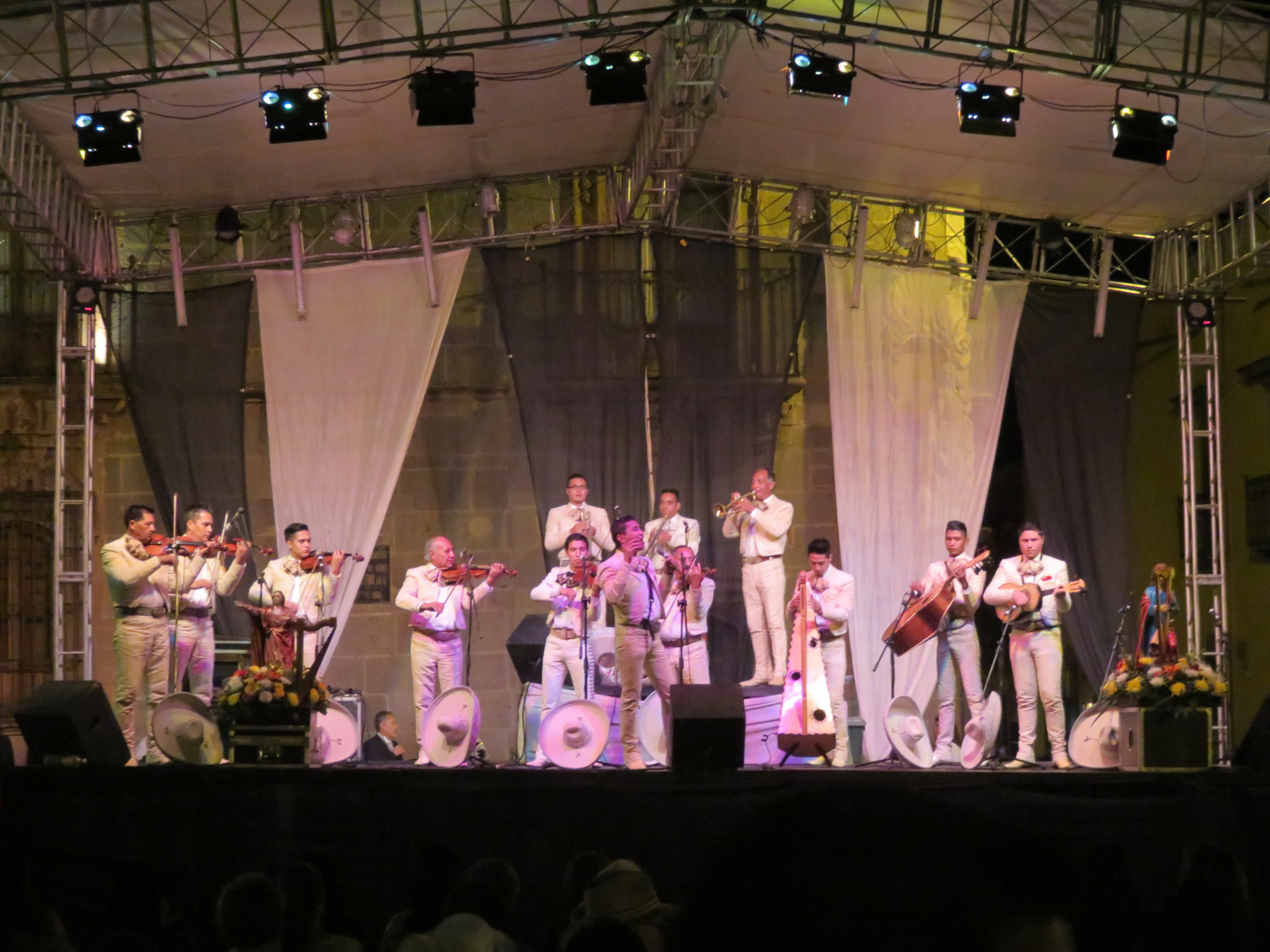
On the way home we passed the Jardin Principal, where they had set up a stage and a band was playing. Every weekend here is a cause for celebration. The night was warm and it seemed everyone was out enjoying the music. This weekend's Fiesta was in honour of St Cecilia, who is the patroness of musicians and whose feast day is Nov 22nd.
Only one week today and I will be in the air on my way back to Toronto. Back to cold and snow by the sounds of things. Not my preference, but maybe I will be able to get away again soon and escape some of the winter weather.
I have a busy week as I try to cram on all the important sights and activities. Stay tuned for my next post on Friday.
Saturday, November 21, 2015
A Walk in the Park
I am sitting here listening to firecrackers, firecrackers that sound like small blasts going off a few houses over. I guess they are still celebrating the 1910 War of Independence as I can also hear music and celebrations. There were lots of these explosions going off last night - so it just may be they have some left over. Fireworks, the loud kind, are a part of life here. They set them off for festivals, birthdays, weddings - seemingly any reason at all. They are homemade and really more for the noise than anything else, I think, given that I hear them day and night, at least several times a day. I wonder how many people end up in hospitals with their homemade mini bomb blowing up in their face?
Anyway, I must get on with today's blog as I am meeting folks at Hecho at noon! This is a bit of a catch up for the week past as yesterday I covered Friday's parade.
Tuesday night I again went to the Women's Club happy hour and enjoyed some company and chit chat before wandering home. Wednesday was writing and the walking and was followed by dinner at Francesco's, an Italian restaurant where there was 2 for 1 pasta. We were joined by another friend of Marc and Sue's who lives here year round and hails from New Jersey.
On Thursday, I got up and headed straight out to walk the 40 minutes uphill through the Balcones neighbourhood to the El Charco Del Ingenio Jardín Botánico y Reserva Natural in order to arrive by 10 am for a guided tour of the park. The El Charco is a nature preserve of some 500 acres including and surrounding a large canyon and a small lake formed by a man made dam. There are also small pools down below the dam which are fed by fresh spring water. The Jardin is maintained by a private non profit foundation with the mission to preserve and maintain the garden and park trails and to plant and encourage local plant species. They have also a large area transplanted with "rescue plants", taken from sites endangered by construction of local dams.
 |
| Map from the Brochure |
There are two tours a week, on Spanish and one English (80 pesos). The revenue from tours plus park admission (40 pesos) and a small cafe are used to raise money to support the Jardin. Our guide was a volunteer at the Jardin, a Seattle native and geologist by profession, who with his wife and then 8 year old son had sold all and gone off travelling through Asia and the Pacific several years ago. They ended up in San Miguel last year, not quite ready to go home, and they have set down roots here, at least temporarily while they figure out what is next. I have met many wandering sorts here...San Miguel has a lot to offer those who can get away from the rat race.
 |
| Looking down on the dam from the lookout point at Plaza of the Four Winds |


I was joined on the tour by 2 women who were from, guess where? - Toronto, Canada. As I say that I realize that the majority of gringos I have met here are Canadians. I have been told that the number of Americans coming here reduced a lot after the 2008 downturn and maybe that is the reason, but in any case, I have not found a majority of Americans here, as I was expecting. Equally surprising, is that the majority of tourists seem to be Mexicans, mainly here on the weekends. I had not expected that either.
 |
| A greenhouse conservatory of Mexican plants, some of which are local to lower altitudes and in need of night time protection against cold. |
 |
| The greenhouse - a conservatory of Mexican plants which are native |
 |
| Plaza of the Four Winds |
This is a ceremonial place which overlooks the canyon. The aboriginal Mexican beliefs are intertwined with the Caltholic symbols here.

 |
| Sorry, the morning was cloudy and the pics are not so good, will try to go back and retake these, if I can before I leave. |
 |
| The suchil is replaced each year with a new one made by local aboriginals. |
 |
| This structure is used as a solar observatory. |


This display is to remember the 43 men who were kidnapped in 2014. It reminds that Mexico is still a dangerous place, although SMA seems to be almost a Garden of Eden within its borders.

 |
| You can walk across the cement dam to access the trails on the other side, as well as the "Ruinas de la Haciendas" which is sometimes used as a sweat lodge. |
 |
| The watermill ruins |
| Below the dam is an area which used to be an area of mill works from long ago. |
| The watermill ruins |

There is an annual concert in this area at spring equinox time, taking advantage of the natural amphitheater .
 |
| Looking down into the the natural spring pool, "El Charco del Ingenios, after which the Park is named. |


 |
| The big pipe called "tubo", which originally brought water down to the textile mills at Fabrica Aurora. |
 |
| Golden Barrel Cactus in the plant rescue area |

I have posted far more pictures than I had intended to and I have so many more of the plants I saw in the park, but enough is enough! Later that day, I went down to spend some time at the Art Walk at the Fabrica Aurora, but that will need to keep for another day.
I hope you are enjoying my little travelogue and for those staying with me at a distance, I will post again on Monday.
Subscribe to:
Posts (Atom)